Thursday, 20 December 2012

Why A Principal Created His Own Currency

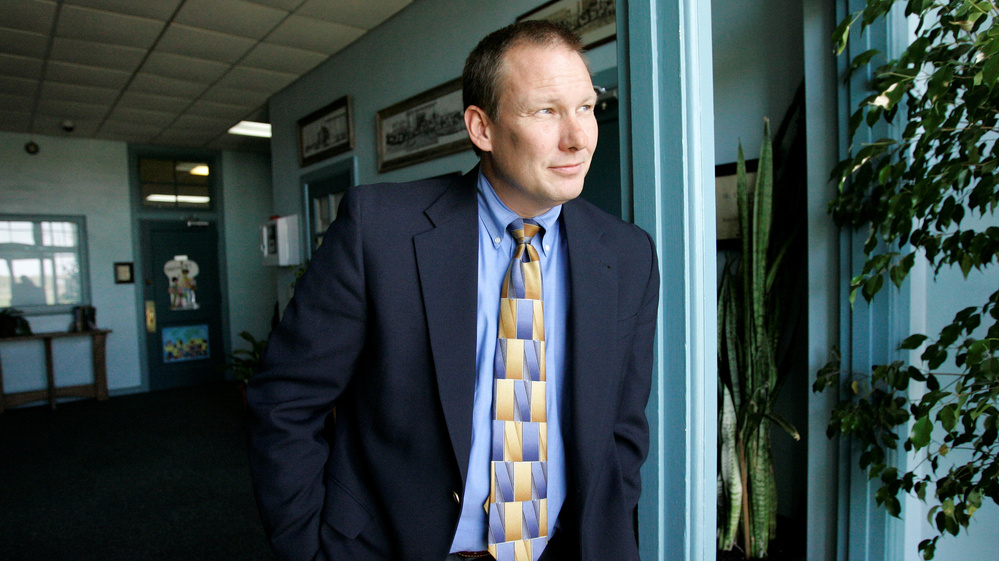
MS 53 Principal Shawn Rux David Kestenbaum/NPR

Shawn Rux took over as principal of MS 53, a New York City middle school, last year. At the time, 50 or 60 kids were absent every day. You could understand why they stayed away: The school was chaos.

Twenty-two teachers had quit, the entire office staff had quit, and hundreds of kids had been suspended. The school was given a grade of F from the city's department of education.

"It was in a bad place," Rux says.

Rux decided he needed to create incentives for kids to come to school. Incentives that were more obvious to middle-school kids than, "If you come to school you'll be better off 20 years from now."

He handed out raffle tickets to anyone who showed up to school on time. One of the prizes was an Xbox. And he threw in an element of randomness: The first kids in line when the doors opened might get 20 tickets.

It worked. Kids started showing up early.

"It was ... like, 'Get out of my way, I'm trying to get into school,' " Rux says. "It was nice."

Rux also created his own currency. He called it Rux Bux. Teachers hand them out when kids are well behaved. They can be traded in for school supplies, or special lunches. A sixth-grader named Wander Rodriguez is trying to save up 5,000 Rux Bux — enough for a personal shopping spree with Rux.

The principal also stands outside school every morning, greeting the students as they show up. This recognition is another, subtler incentive to come to school.

"I like this school," Wander Rodriguez says. "They treat me like home, they treat me nice, they always give me stuff. ... They always say 'hi' in the mornings."

The school went from an F to a C. Daily attendance went up to over 90 percent. Then the hurricane hit.

The school is in Far Rockaway, Queens — one of the areas hardest hit by the storm. Some kids' homes were destroyed. One student who stayed at home through the storm told a teacher, "My apartment complex was in the middle of the ocean." Rux's car was destroyed. The first floor of his house was flooded.

After the storm, after school started up again, Rux's goal was to get attendance back to 90 percent. Every day, his staff texts him the attendance numbers. The day I visited last week, 89.2 percent of students attended school. Close, but not close enough for Rux.

The storm has been tough on everyone, he says. But that's no excuse. Kids have to be in school.


View the original article here

Schools Re-Examine Security After Newtown Shooting

The Connecticut shootings were on the minds of many at schools around the country on Monday. Some school officials re-examined their security procedures over the weekend, while parents dropped off their kids with a new sense of unease.

Copyright © 2012 National Public Radio. For personal, noncommercial use only. See Terms of Use. For other uses, prior permission required.

MELISSA BLOCK, HOST:

In the aftermath of Newtown, school officials and parents across the country were asking themselves the same question today: How safe is my school? NPR's Claudio Sanchez has that story.

CLAUDIO SANCHEZ, BYLINE: In Nashville, Tennessee, Ruth Rosenberg asked her daughter's first-grade teacher what school was going to be like today. Teachers there were told to downplay any discussion of the Newtown shooting since many kids still don't know what happened, including her 7-year-old daughter, says Rosenberg.

RUTH ROSENBERG: It's a 50-50 chance if she does find out, it's going to be from another child - which I wouldn't love, but I also trust the teacher 100 percent to handle it, if that happens; and then I could handle it at home.

SANCHEZ: Rosenberg says she's fought back tears, thinking about Newtown. After she dropped off her daughter this morning, she broke down on the way home. Another parent, Wehsong Zhou, walked his third-grade daughter to school. He's decided not to talk to his child about the shooting. She's just too young to be exposed to such tragedy, he says.

WEHSONG ZHOU: We cannot understand why this has happened, like this. It should not happen. It's against human nature.

SANCHEZ: Across the nation, parents debated whether to keep their kids home. Police departments deployed officers to patrol schools. Administrators reviewed their lockdown procedures; and psychologists and social workers were on standby, to help teachers talk to students who want to discuss the shooting in Newtown. Will Keresztes is associate superintendent of the Buffalo Public Schools.

WILL KERESZTES: Our social workers, and our school psychologists, are really stepping up. They're sharing a lot of information with each other. They're disseminating really good information to teachers with regard to students; and how to talk to students, and how to keep a sense of normalcy as best you can, in a situation like this.

SANCHEZ: In Hamden, Connecticut, just 30 miles east of Newtown, School Superintendent Fran Rabinowitz says nothing feels normal. She's called for a greater police presence on campuses indefinitely, and scheduled a district-wide meeting with parents and staff today.

FRAN RABINOWITZ: Because I felt that there was a feeling of helplessness out there about, so what's going to happen in the schools? And I wanted to bring people together. And it unfolded over the weekend, to the point where we said we need some comfort, too.

SANCHEZ: In Oakland, California, where an average of 20 school-age children are shot and killed outside school every year, district officials are also reviewing lockdown procedures. But district spokesman Troy Flint says most of the focus, for the next few days, will be on students' emotional well-being.

TROY FLINT: Our counselors are onsite. They are always on alert. I think what you need to understand is that we cope with violence on a daily basis here, so we have these procedures in place.

SANCHEZ: In many communities, though, school officials who may have once thought they were immune, are now stressing the need for armed police officers on campuses. Mo Canady is with the National Association of School Resource Officers, which trains most of the nation's 10,000 school police officers. He says arming teachers or administrators, as some have suggested, is another matter.

MO CANADY: There's a part of me that just kind of cringes at the liability of a school district doing that. Now, as of Friday, there are certainly some advocates for that. But it is a dangerous and slippery path to be on.

SANCHEZ: But Francisco Negron, legal counsel for the National School Boards Association, says the Newtown shooting could change some people's minds about that.

FRANCISCO NEGRON: It is a turning point. Now, the focus is on an external shooter. And so I think schools are going to try to understand whether or not they need to change their policies accordingly.

SANCHEZ: What those changes will be, Negron says, it's hard to say. But school safety policies, in the short term, will probably shift to more sophisticated surveillance technology, and a greater law enforcement presence in all schools. Claudio Sanchez, NPR News.

Copyright © 2012 National Public Radio. All rights reserved. No quotes from the materials contained herein may be used in any media without attribution to National Public Radio. This transcript is provided for personal, noncommercial use only, pursuant to our Terms of Use. Any other use requires NPR's prior permission. Visit our permissions page for further information.

NPR transcripts are created on a rush deadline by a contractor for NPR, and accuracy and availability may vary. This text may not be in its final form and may be updated or revised in the future. Please be aware that the authoritative record of NPR's programming is the audio.


View the original article here

Among Schools With Shootings, A 'Tragic Fraternity'

Melissa Block talks to Chris Dunshee, former principal of Red Lake High School in Red Lake, Minn. In 2005, a student shot and killed seven people on the school's campus.

Copyright © 2012 National Public Radio. For personal, noncommercial use only. See Terms of Use. For other uses, prior permission required.

MELISSA BLOCK, HOST:

In 2005, Red Lake High School in northern Minnesota was the scene of another school shooting. In all, 10 people died, including the 16-year-old shooter. When I went to Red Lake soon after the attack, I talked with the school principal, Chris Dunshee. He told me Red Lake had joined what he called a tragic fraternity along with schools in Columbine, Colorado, and Paducah, Kentucky. When I reached Dunshee today, he sad the Newtown shooting had brought painful memories flooding back.

CHRIS DUNSHEE: I mean, the pain never stops, but the interval between the pain just gets longer. And I think that's kind of the message that I would share with Newtown, that don't look for the pain to ever go away, but it will - the time between will grow longer. It's, you know, like a scab that grows over the wound, and you become numbed to some of that until something like this happens again.

BLOCK: Mm-hmm. You had told me back in 2005 that there were a couple students from Columbine who came to Minnesota to try to be of some help. You didn't know they were coming. They just came.

DUNSHEE: No, they just showed up. And I was reading on one of my Facebook pages last night that some of the kids from the 2008 class, or the class that had those students - the students were in their class that were killed here at Red Lake are actually trying to raise money to go out there and be with the people in Newtown. And, yeah, they remembered those students from Columbine. They remembered how much that helped them, and they're looking and turn now to see if they can do anything that would ease the pain.

BLOCK: You know, I was thinking, Chris, that the date of these tragic events becomes indelible in these communities: for you in Red Lake, March 21, at Virginia Tech it's April 16, and now for Sandy Hook it's going to be December 14. Does that date for you ever come around, March 21, when you don't immediately remember what happened there?

DUNSHEE: No, March 21 is a date that I'll always be aware of.

I was thinking this morning, you know, as kind of an aside - we just got a couple little puppies here not too long ago, and their birth date was March 21. And I told my wife, I said, I'm not sure I can get them. And she made a good point. She said, you know, it's time something good happened on March 21. And so we got the puppies. We're really happy about it.

(LAUGHTER)

BLOCK: Something good coming from that date.

DUNSHEE: That's exactly right. Yeah. Yeah.

BLOCK: Well, I know this is - it's a very different community in Connecticut from yours there in Minnesota, a very different school, very different ages of the kids. But if you could talk to people there in Newtown, what would you tell them? What would you want them to know?

DUNSHEE: Well, there comes a time when you just become so weary that you just don't want to think about it anymore. You just want to smile and laugh again and - but you're almost afraid that someone will think you're callous or unfeeling if you do that. But I know they're going to feel the same way. They're going to be so saturated with this for so long. I just hope that somehow these tragic events don't get tied to the season so that these people will, again, be able to feel that peace and understanding that, you know, that the holidays are supposed to bring.

BLOCK: Well, Chris Dunshee, it's very good to talk to you again. Thank you so much.

DUNSHEE: Thank you, Melissa.

BLOCK: Chris Dunshee was the principal of Red Lake High School in Minnesota during the school shooting there in 2005.

Copyright © 2012 National Public Radio. All rights reserved. No quotes from the materials contained herein may be used in any media without attribution to National Public Radio. This transcript is provided for personal, noncommercial use only, pursuant to our Terms of Use. Any other use requires NPR's prior permission. Visit our permissions page for further information.

NPR transcripts are created on a rush deadline by a contractor for NPR, and accuracy and availability may vary. This text may not be in its final form and may be updated or revised in the future. Please be aware that the authoritative record of NPR's programming is the audio.


View the original article here

Profiling A Shooter: 'Needle In A Haystack'

After an elementary school shooting in Connecticut, Americans continue to struggle to understand why it happened and how to prevent future tragedies. Host Michel Martin discusses the shooting with author Paul Barrett, journalist Craig Whitney and psychiatrist Carl Bell. They talk about the politics and psychology of America's gun culture.

Copyright © 2012 National Public Radio. For personal, noncommercial use only. See Terms of Use. For other uses, prior permission required.

MICHEL MARTIN, HOST:

This is TELL ME MORE from NPR News. I'm Michel Martin. Later in the program we are going to revisit a story that caught our attention about poverty in a place that often seems overlooked. We'll hear about a young woman in the Rust Belt trying to figure out a path to a better life.

But first we want to talk about the story that no one can overlook: the shooting at the elementary school in Newtown, Connecticut, last Friday, where 27 people, including 20 small children, were killed by a gunman who then took his own life. It is, sad to say, not the only mass shooting in recent memory in this country; it is the latest. It has the president calling for action.

PRESIDENT BARACK OBAMA: Can we honestly say that we're doing enough to keep our children, all of them, safe from harm? Can we claim as a nation that we're all together there, letting them know that they're loved and teaching them to love in return? Can we say that we're truly doing enough to give all the children of this country the chance they deserve to live out their lives in happiness and with purpose?

I've been reflecting on this the last few days, and if we're honest with ourselves, the answer is no. We're not doing enough. And we will have to change.

MARTIN: There's already been a lot of talk about exactly what kind of change, if any, should come after Friday's shooting. And we'll talk about that, but we also want to talk about how we got here in the first place. So we're joined by three people who have thought and written a very great deal about the relationship Americans have with guns and with violence.

Craig Whitney is the author of the book "Living with Guns: A Liberal's Case for the Second Amendment." He spent more than 40 years as a reporter, foreign correspondent, and editor at the New York Times. Dr. Carl Bell is a psychiatrist and a professor at the University of Illinois at Chicago. He's also the founder of the Institute for the Prevention of Violence and he joins us from time to time to talk about important issues like this.

Paul Barrett is the author of the book "Glock: The Rise of America's Gun." He's also an assistant managing editor and senior writer at Bloomberg Businessweek. And I want to thank you all so much for joining us.

DR. CARL BELL: Thanks for having us.

PAUL BARRETT: Thank you.

CRAIG WHITNEY: Thank you.

MARTIN: Before I get to my questions, I just wanted to ask each of you briefly, what strikes you about what just happened? And Dr. Bell, I'll start with you.

BELL: Well, what strikes me is that this is another suicide preceded by mass murder, but the dynamic of suicide is being overlooked. And the notion that the more you publicize this, the more copycat phenomenon you get as a result.

MARTIN: Interesting. Craig Whitney, what strikes you?

WHITNEY: Well, it is a fact that more than half of all the gun deaths in this country every year are suicides. What strikes me about this incident, though, is that it's so horrific that if anything can change the paralysis that we've seen in the ability to talk about what might be done to stop or make less frequent awful things like this, this is it, the Newtown massacre.

MARTIN: Paul Barrett, what about you?

BARRETT: I'm struck by the consistency of the psychological and demographic profiles of the young men who pull off these horrendous crimes. You know, it seems like they practically come from Central Casting in terms of what we learn about their lives, what we learn about the warning signs the people saw in the months and years leading up to these horrible events, and what we learn about their relatively easy access to firearms.

MARTIN: Paul Barrett, tell me more about that. What do we - tell me what you think those elements are. And then, of course, I want to hear from Dr. Bell on that as well. And I do have to say, from the standpoint of us as a news organization, we don't feel that we know as much as we would like to know at this juncture...

BARRETT: Yeah.

MARTIN: ...about this young man and what we can actually confirm. So with that being said, Paul, what do you mean by that?

BARRETT: Well, you know, young men in their late teens, early 20s, who, you know, seem to have considerable intellectual interests of one sort or another, have various talents. These are not complete losers and yet have deep psychological problems of some sort that people have been kind of murmuring about around them for some substantial period of time and then, as the doctor said, decide that they're going to commit suicide and bring down a lot of other people with them as a show of their pain.

BELL: Yup.

BARRETT: That to me seems to be quite a consistent profile for the people, particularly in these school shootings.

MARTIN: Dr. Bell, what about that? Does that sound right to you?

BELL: No, that's absolutely right. The problem is, is that if you get into trying to profile and identify, you're looking for a needle in a haystack. Because a lot of people have those characteristics, and that makes it all the more difficult to try to identify that unique individual.

You know, we've been doing suicidology and trying to prevent suicide for the last 30 years and we haven't decreased it at all. And these suicides preceded by mass murder are even more rare. And so it's an extremely difficult challenge.

MARTIN: Craig Whitney, I wanted to pick up on something you said, which is that if anything could force us as a country to take a serious look at all these things that we need to think about, it could be it. Is that really true? I mean I remember covering a number of these stories - too many - and at every turn I remember thinking, well, this is the moment in which it changes.

I'm thinking about the story where the young kids, the other kids at a school in Boone, Arkansas killed other kids. And I'm thinking, of course, about Columbine, as everybody does. But is there really any evidence that these kinds of things change policy, Craig Whitney?

WHITNEY: Well, we'll find out in coming days and months, but it's been a long time since we've had the mass slaughter of 20 first-graders by gunfire in a classroom. And I think picking up on what the doctor and Mr. Barrett said, it's certainly true that if we had better ways of identifying people with problems of mental instability, that would've kept the shooter in the Aurora movie theater massacre from buying the guns that he was able to buy and use in that incident.

You're not ever going to be able to stop these things completely, but we could do things that might reduce their frequency and I think doing nothing is just not an acceptable alternative anymore.

MARTIN: We're speaking with journalists Craig Whitney and Paul Barrett, and Dr. Carl Bell, a psychiatrist. We're talking about the shooting at Newtown, Connecticut. Dr. Bell?

BELL: Well, you know, one thing that we could do is to try to figure out how to follow the guidelines about reporting on suicide. Now, I know that's difficult because this is such a huge media event. But if you look at the guidelines around individual suicide, the journalists are very clear that you shouldn't report details about how this was done.

So it seems to me that the more we report that this sort of an assault weapon was used, that this person had this kind of bulletproof vest, that this person entered the school this way, that gives other people who are depressed and suicidal and want to take a whole bunch of people with them the knowledge on how to pull it off. And so that could be changed fairly easily.

MARTIN: Really? Well, talk more about that, if you would. I mean you're suggesting that people...

BELL: We know that for individual suicides - this was work done by Phillips in 1974, when papers were local and a newspaper would publicize a suicide event, an individual suicide event, and then two, three weeks later you'd find cluster and copycat suicides. So the Vandenberg School of Journalism at Columbia said, well, we've got to stop this so let's not put it on the front page, not on how you do that with this.

But let's not describe with accuracy how it was done so other people who are thinking in the same way won't be able to replicate the event.

MARTIN: That's a difficult question, of course, as you're surrounded by journalists in this conversation.

BELL: I know.

MARTIN: Of something of such public interest and significance. How would one do that without addressing other important values in our country? But, you know, to that end of a question of what can be done, I wanted to ask the two journalists about the kinds of things that you've reported on over the years and the deep reporting that both of you have done about what exactly can you do.

I know Craig Whitney, your book - I just quoted it very recently, in fact, where you pointed out that there are already, what is it, something like 300 million guns in circulation in the United States now, and 100 million handguns?

WHITNEY: Mm-hmm.

MARTIN: So, Craig, given that there are that many guns in circulation in the United States right now, what can one do?

WHITNEY: Well, the problem that we have is how do you keep guns out of the hands of people whom everybody agrees shouldn't have them, like Adam Lanza? He stole his guns, I guess, from his mother before he shot her to death. Perhaps she transferred them to him. That isn't known at this point. If she did, she broke the law.

We can tighten up laws that, for instance, make it a crime to buy a gun from somebody who is on the national instant check system database as being barred from buying a gun from a dealer. We should tighten up regulations like the requirement, I mean, that now doesn't exist, if you buy a gun from a private owner, your name doesn't have to be checked with the database.

This wouldn't stop all incidents like this horrific one in Newtown, but it would stop a lot of routine gun violence that happens in our cities with other kinds of weapons.

MARTIN: Paul Barrett, I want to hear from you, as well. And we're going to need to take a short break in just a minute, and we'll continue this conversation after that break. But Paul Barrett, what about that?

BARRETT: Yeah. Well, I do not disagree with anything Craig said. I would just emphasize something different, which is that we're in a fix. We've got the 300 million guns out there. We are not going to confiscate those guns. And as a result, the presence of that armory will intersect with mental illness. It will intersect with criminality. And tinkering with the rules for how new guns are acquired will have only marginal effects, at best, at controlling these crimes. So that's the kind of grim reality that I would emphasize.

MARTIN: We need to take a short break, but when we come back, we'll continue this conversation with our guests. They are journalists Paul Barrett and Craig Whitney. They've both been deep reporting about the place of guns in American life and the politics of that. And we're also joined by psychiatrist Dr. Carl Bell, who has focused quite a lot on the prevention of violence and the aftermath of violence.

I'll ask all of you to please stay with us as we take a short break. This is TELL ME MORE, from NPR News. I'm Michel Martin.

Copyright © 2012 National Public Radio. All rights reserved. No quotes from the materials contained herein may be used in any media without attribution to National Public Radio. This transcript is provided for personal, noncommercial use only, pursuant to our Terms of Use. Any other use requires NPR's prior permission. Visit our permissions page for further information.

NPR transcripts are created on a rush deadline by a contractor for NPR, and accuracy and availability may vary. This text may not be in its final form and may be updated or revised in the future. Please be aware that the authoritative record of NPR's programming is the audio.


View the original article here

Ct. Teacher Struggles With What To Tell His Students

Kyle Mangieri teaches 7th grade social studies in Fairfield, Ct. On Friday, he found out about the school shooting while he was at work. Mangieri lives very close to Sandy Hook Elementary School. He goes back to his classroom on Monday while deciding what to tell his students.

Copyright © 2012 National Public Radio. For personal, noncommercial use only. See Terms of Use. For other uses, prior permission required.

DAVID GREENE, HOST:

Now, across the country today, teachers and students are heading back to school, three days after the Sandy Hook shooting in Newtown, Connecticut. And this won't be an easy day for anyone in the school setting - parents, children, school administrators. For one Connecticut teacher, it will mean talking about what happened just a few hundred feet from his home.

From member station WNYC, Brigid Bergin has his story.

BRIGID BERGIN, BYLINE: Kyle Mangieri loves his job. This is the first year the 27-year-old has been teaching Social Studies to seventh graders in Fairfield, Connecticut full-time. Mangieri is also the basketball coach and literally gives his middle schoolers something to look up to.

KYLE MANGIERI: Yeah, I'm 6'5".

BERGIN: On Friday, he was in his classroom in Fairfield, about half-an-hour from Newtown, when he found out about the shooting at Sandy Hook Elementary School. As details trickled out all day, he started to lose his focus.

MANGIERI: At 12:30, when I had a break, I looked at my phone again and I had a bunch of missed texts.

BERGIN: Finally, he told his principal where he lived and said he needed to leave. While Mangieri teaches in Fairfield, he lives in Sandy Hook, right at the base of the hill that leads up to Sandy Hook Elementary School.

When he got home Friday, he saw frantic parents rushing up that hill to the school. Many walked back with their children, often in tears. Others returned alone.

MANGIERI: They looked like zombies. They looked like they'd just been given the worst news of their life.

BERGIN: Yesterday, across from his porch, police officers were directing traffic at the intersection. The road to the school is still blocked off. But a steady stream of mourners and media go back and forth from a makeshift memorial at the school's entrance. The school itself is still a closed crime scene.

Mangieri made a banner that hangs from his window that says: God Bless Sandy Hook. His family also turned the front yard over to a church group so its members could set up a display in Christmas lights that reads: Faith, Hope and Love.

His father, Chris, came to town yesterday so they could watch the Giants football game at a local bar and get a bit of a reprieve. But Mangieri, Sr. mainly just wanted to hang out with his son.

CHRIS MANGIERI: I'm a Dad, you know. I remember him and his sister being in middle school. And if this ever happened when they were there, I don't know what I would have done. I mean I would have - the panic would have been ridiculous.

BERGIN: Today, Kyle leaves his home in Sandy Hook and heads back to his Fairfield classroom. His superintendent sent out an email over the weekend telling teachers things will be a little different. He has to go to school extra early so teachers can meet first with guidance counselors. Then all the teachers will meet the students at the front door.

MANGIERI: And once school begins and all the students are in, every single door will be locked. And that was never the case before.

BERGIN: His class is currently studying geography, but Mangieri plans to set that aside today. His students know where he lives. And he knows they'll have questions.

For NPR News, I'm Brigid Bergin in Newtown, Connecticut.

Copyright © 2012 National Public Radio. All rights reserved. No quotes from the materials contained herein may be used in any media without attribution to National Public Radio. This transcript is provided for personal, noncommercial use only, pursuant to our Terms of Use. Any other use requires NPR's prior permission. Visit our permissions page for further information.

NPR transcripts are created on a rush deadline by a contractor for NPR, and accuracy and availability may vary. This text may not be in its final form and may be updated or revised in the future. Please be aware that the authoritative record of NPR's programming is the audio.


View the original article here

Teenager's Faith At Odds With Locator Tags In School IDs

A federal court in Texas on Monday will take up the case of a high-school student who refuses to wear her location-tracking school ID.

The 15-year-old sophomore says the ID badge, which has an embedded radio frequency identification tag, is a violation of her rights. The student, Andrea Hernandez, believes the ID is "the mark of the beast" from the Book of Revelation.

Steven Hernandez says his daughter was alarmed this summer when John Jay High School in San Antonio informed families that new IDs would include the chips, which would help the school know electronically if the student was on campus.

"And she says, 'Daddy, I'm not going to do this.' And I said, 'Why aren't you going to do this, honey?' She says, 'Dad, that's exactly what it talks about in the Book of Revelation that you were teaching us about taking the mark of the beast. This is the exact same thing,' " Hernandez says.

The Hernandez family is evangelical Christian and attends John Hagee's Cornerstone Church in San Antonio.

"The mark of the beast is what the Antichrist is going to use so he can track the people," Hernandez says.

The Antichrist in his daughter's situation, Hernandez says, is Northside Independent School District.

This is where many parents would part ways with the Hernandez family. But even if they don't view school administrators as the Antichrist, some other parents do have privacy concerns about the tracking chips.

John Whitehead is a lawyer with the Rutherford Institute in Virginia, which fights government infringement of individual rights. Whitehead is representing the Hernandez family in federal court.

"They're just not going to do it. I deal with a lot of religious folks. Anything endorsing something they feel is unconstitutional or that violates their religion, they're just not going to do. So the easiest thing for the school here is to opt out," Whitehead says. "The problem is, when we got involved in the case and a lot of publicity erupted and a lot of other people have joined in now, so the school is probably going to fight this or the program itself is going to be up for grabs."

When Whitehead says the school should opt out, he means the school should let Andrea Hernandez opt out of having to carry the locator chip. That's something the district has offered as long as Hernandez still wears the new ID badge with no chip inside. But Andrea doesn't want to do that either. She wants to wear her old school ID.

For the school district, this is all about money. The state of Texas slashed funding to public schools by more than $5 billion. Districts all over the state, rich and poor alike, many exploding in population, are desperately underfunded.

"The school district receives federal funding based upon the number of students who are in attendance each day at school," says Craig Wood, the lawyer for the Northside Independent School District. "Given that we've got a crisis in educational funding in the state of Texas, we're trying to recapture every dollar that we can in order to try to do more and more with fewer and fewer resources."

The chip program is costing Northside $500,000, but the district expects to recover about $1.7 million more from the federal government. So that's $1 million worth of teachers Northside doesn't have to let go. The chips have been successfully introduced in a school district near Houston without fanfare.


View the original article here

New Logo At University Of California Causes Uproar

There is uproar over the newly designed logo for the University of California. Students and alumni around the state are up in arms, saying the new logo is ugly and simplistic and does not convey the heritage and prestige of the institution.

Copyright © 2012 National Public Radio. For personal, noncommercial use only. See Terms of Use. For other uses, prior permission required.

AUDIE CORNISH, HOST:

From NPR News, this is ALL THINGS CONSIDERED. I'm Audie Cornish.

ROBERT SIEGEL, HOST:

And I'm Robert Siegel.

The University of California is no stranger to protests over wars, tuition hikes, budget cuts, you name it. But the 10-campus system is seeing a different kind of revolt this week.

As NPR's Richard Gonzales reports, it is a resounding rejection of the university's new logo.

RICHARD GONZALES, BYLINE: Since 1868, the University of California has been represented, visually speaking, by a seal featuring a star shining on an open book and the script Let There Be Light. But there's not much light when the seal is replicated on a piece of apparel or in a digital field, say for example, a Twitter icon, says UC's marketing communications director Jason Simon.

JASON SIMON: When it's used, you know, at the size of less than a dime, you don't get any of that detail.

GONZALES: Several months ago, the university unveiled a new, sleeker and more modern logo. It's a large C in a stylized blue U-shape topped with the silhouette of an open book. In one version, the C is solid. In another, it's a gradient C which appears to be moving or fading.

AARON BADY: I said it looks like a Swedish flag being flushed down the toilet.

GONZALES: It would be an understatement to say that the new UC logo is being panned on the Internet.

DAVID PETERSON: I just have to tell you, it looks like kind of a minor league American soccer logo, rather than the logo of a very proud educational institution.

BRITTAN TROZZE: I hate to say it but it reminds me of a tampon brand maybe, something that's young and fresh and sort of supposed to be discreet.

DOUGLAS SAUNDERS: To me it's bad graphics, it's bad politics, it's bad marketing. It's just bad.

(LAUGHTER)

GONZALES: Those are the opinions of Cal alums and students Aaron Bady, David Peterson, Brittan Trozze, and Douglas Saunders. Some, if not all, are among the more than 53,000 people who have signed an online petition asking the University to withdraw the new logo.

The reaction has caught UC officials off guard. Marketing communications director Jason Simon says the logo has been out nearly nine months, so it's really not new.

SIMON: It's been on Web site. It's been on a mobile tour that we moved throughout the state. You know, we engaged 60,000 people in those things. So my only surprise really is not necessarily the reaction, it's that we're just getting this reaction now.

GONZALES: And Simon says the university never intended for the new logo to replace the old seal, which will still appear on diplomas. And he says the university has no plans to withdraw the much-maligned logo.

Richard Gonzales, NPR News, San Francisco.

Copyright © 2012 National Public Radio. All rights reserved. No quotes from the materials contained herein may be used in any media without attribution to National Public Radio. This transcript is provided for personal, noncommercial use only, pursuant to our Terms of Use. Any other use requires NPR's prior permission. Visit our permissions page for further information.

NPR transcripts are created on a rush deadline by a contractor for NPR, and accuracy and availability may vary. This text may not be in its final form and may be updated or revised in the future. Please be aware that the authoritative record of NPR's programming is the audio.


View the original article here

Amid Calls For Gun Control, Some Push For Weapons At School

David Thweatt, the school superintendent in Harrold, Texas, is seen in 2008. Troubled by school shootings around the country, Thweatt decided to arm school staff.

Tony Gutierrez/AP David Thweatt, the school superintendent in Harrold, Texas, is seen in 2008. Troubled by school shootings around the country, Thweatt decided to arm school staff. David Thweatt, the school superintendent in Harrold, Texas, is seen in 2008. Troubled by school shootings around the country, Thweatt decided to arm school staff.

Tony Gutierrez/AP

A growing number of lawmakers are indicating they are open to considering new gun control measures in the wake of Friday's school shooting in Newtown, Conn. But while much of the national debate has focused on limiting access to guns, others are suggesting that schools should arm themselves to defend against attacks.

David Thweatt, school superintendent for the small Texas town of Harrold, northwest of Fort Worth, decided in 2006 that it was time to arm his staff. There's only one school in Harrold, a K-12 with 103 students.

Before 2006, there had already been enough carnage at U.S. schools that Thweatt had cameras installed, as well as magnetic locks that could be thrown at the first sign of trouble. But then came the Amish school shooting in October 2006, when 10 girls, ages 6 through 13, were shot.

"And that concerned us, because that was the milk delivery man. We would have let a milk delivery man into our school," Thweatt says. "We would have allowed him to come in. Then we would have had an active shooter."

Just months later, a gunman at Virginia Tech shot 49 people, killing 32.

"Basically, our plan was [the same as] Virginia Tech," Thweatt says of his school's policy at the time. "You lock the doors, secure it. And then get the kids under the desk or get them out of the way of possible stray bullets. But that's exactly what everyone at Virginia Tech did."

Can Lawmakers Prevent Mass Shootings?

After last week's elementary school shooting in Connecticut, President Obama promised to use whatever power he has to prevent another mass shooting. Host Michel Martin speaks to Republican strategist Ron Christie and Keli Goff of The Root, to discuss how the debate could play out on Capitol Hill.

Copyright © 2012 National Public Radio. For personal, noncommercial use only. See Terms of Use. For other uses, prior permission required.

MICHEL MARTIN, HOST:

This is TELL ME MORE from NPR News. I'm Michel Martin. Coming up, now that a couple of states have legalized the recreational use of marijuana, can parents still tell their kids to just say no? We'll hear from a pediatrician who works with substance-addicted teens about why it's still important to have the talk about drug use, and to pay attention to what you as a parent are modeling with your own behavior. That's coming up.

But, first we want to talk about a new debate that's gathering force in Washington and around the country about gun control. That's of course coming in the wake of the shooting in Connecticut that left 28 people, including 20 children and the gunman dead. The carnage has caused a number of lawmakers who have been hostile to gun control in the past to say that they are now rethinking their positions.

So we thought this would be a good time to call two of our political analysts to talk about this. Keli Goff is a political correspondent for TheRoot.com. That's an online publication. Also with us once again, Ron Christie. He's a former aide to Vice President Dick Cheney and President George W. Bush. He's now the president of Christie's Strategies, a media and political strategy firm.

Welcome back to you both. Thank you both for joining us.

KELI GOFF: It's great to be back.

RON CHRISTIE: Nice to be with you.

MARTIN: Ron Christie, traditionally Republicans are associated with a very expansive view of gun rights, but there has been legislation in the past the Republicans have supported, at least some. For example, there was a 10-year ban on so-called assault weapons that was passed in 1994 that later expired, you know, 10 years later.

What are the conversations now going on among Republican lawmakers about this?

CHRISTIE: Very spirited, from the people I've spoken to on Capitol Hill. And I think it divides in two camps. One, which people believe that the constitution enshrines the right to bear arms in the Second Amendment and that gun control legislation won't address the terrible tragedy of what happened.

And then number two, I think there's a group that says, OK, the Second Amendment does enshrine that right but does it enshrine the right to have armor-piercing bullets? Does it enshrine the right to have military-type weaponry? And I vividly remember this conversation, Michel, because I worked for then-Congressman John Kasich who's now the governor of Ohio as his legislative director in 1994.

And we wrestled with this for days and he ended up voting - one of the handful of Republicans who voted for it at the time. And if you look at the specifics of that legislation of a grenade launcher, a bayonet mount, a pistol grip, that you come to say these are designed to kill people rather than to hunt. And so it's a very spirited debate in the Republican circles on Capitol Hill now.

MARTIN: Keli, important to note, though, it's not just the Republican Party that's been opposed to more gun control in the past. There are a number of Democratic senators who have so-called A ratings from the National Rifle Association which is the most, you know, prominent gun rights lobby. Democratic senator Mark Warner from Virginia, for example, is one of those.

He told WTVR TV in Richmond, though, that the status quo has to change. Let me just play a short clip from him.

(SOUNDBITE OF TV SHOW)

REPRESENTATIVE MARK WARNER: I've had an NRA rating of an A but, you know, enough is enough. I've got - I'm the father of three daughters and this weekend they all said, Dad, you know, how can this go on? And I, like I think most of us, realize that there are ways to get to rational gun control.

MARTIN: We heard similar remarks, for example, from Senator Joe Manchin from West Virginia who's also had a so-called A rating from the NRA and he says everything has to be on the table now. What kinds of conversations are going on among Democrats on this?

GOFF: Well, I don't know specifically in terms of, you know, what they're actually strategizing about but I will say - and another person I think on this list, and correct me if I'm wrong here, is Senate Majority Leader Harry Reid. Right? He's always had a very high rating from the NRA which a lot of people sometimes forget.

But that actually instrumental when he was in that tight race a few years back. But, look, I will say this. I think what's interesting, Michel, is that I have really never met a person who is truly against any form of gun control. I really haven't. And I'm not saying that to be funny. I'm not saying that to be flip. I mean I've very rarely met someone who says I am a huge fan of Osama bin Laden.

I think what he did was great. I'm going to join a couple of groups who are interested in hurting Americans. Oh, and by the way, I'd like to have access to a AK-47 this afternoon and show up at an elementary school. I'm not going to tell you why I'm going. I have not met a person who says they think that's OK. Right?

So I think at this point the reality is setting in that the majority of Americans do support gun control, regardless of party affiliation. The quibbling in our country has always been on how far, how much. And I think that, you know, as polls were breaking just in the last 48 hours showing that the number of Americans who were willing to have a bigger conversation, a larger conversation, of expanding how much gun control we have in this country, the numbers have shot up something like 20 points.

Since the last time they polled on this issue. Twenty points. So that's a huge increase. So I think that we shouldn't be surprised to see that a lot of politicians on both sides of aisle who were fearful of the NRA and therefore fearful of really talking about expanding some of these measures are going to find their courage again in a way they didn't find it after the Aurora shooting because it was a couple months before an election. And that's just the truth.

MARTIN: I wanted to ask you a little bit more about that and just by way of clarification. Harry Reid had a B rating from the NRA which is, you know, not bad but he wasn't considered one of their most favored legislators. But, you know, to your point, though, you also wrote an interesting piece.

And this is a point of view that's been much discussed in African-American-oriented media where you made the point that movement on gun policy tends to happen when the people who are the targets are people whom lawmakers identify with.

GOFF: Right.

MARTIN: Could you talk a little bit more about that? Which is kind of a sad thing in a way, if you think about it.

GOFF: Yeah.

MARTIN: But maybe it's a human thing. I don't know.

GOFF: Yeah. You know, it's interesting because as tragic as, you know, the loss of those 26 lives were in Newtown, I mean, the point that I made was that in Chicago this summer there were 26 young people shot in one night. Twenty-six. And yet a lot of people didn't know that till my column ran because that's how little coverage it got. Right?

And so the point I'm simply making is that, just like we saw after Columbine, where gun violence had been one of the leading causes of death of young black teens for, like, a decade and then after Columbine we get the Million Mom March. We get assault weapons banned. We get all this movement on it after - excuse me, the assault weapons ban didn't happen before Columbine.

But in terms of mobilization around the issue of gun control it didn't happen until it touched kids in the suburbs, you know, whose parents kind of look like a lot of our elected officials. And I want to be clear, though, Michel, you know, I think that the responsibility can't just be dropped in the lap of our elected officials because they only do what we allow them to. I think there has to be a responsibility borne on the part not just of voters and citizens but also the part of the media because we're dropping the ball if we allow stories like Newtown to dominate coverage, which it should - I'd much rather see that get coverage than Kardashian or the Petraeus scandal - but we should also have been covering the fact that more people died of gun violence in Chicago in the first half of this year than were killed in Afghanistan.

MARTIN: We're talking with Keli Goff of TheRoot.com and political strategist Ron Christie about political conversations happening in the wake of last week's shooting in Connecticut. You know, tough to turn to other matters but we do want to mention the other big political story that still is with us and not to diminish at all, of course, the emotion and the concern that we have for the families who are still dealing with this terrible situation in Connecticut that really has touched all of us.

But I do still want to talk about the other big issue on Capitol Hill which is the so-called fiscal cliff. That's that package of spending cuts and tax increases that will go into effect if the White House and Congress don't reach agreement. There are reports that the president and House speaker John Boehner are getting closer to a deal.

So, Ron, I'll ask you. Reports suggest that Speaker Boehner conceded that tax rates for some top earners would go up. Do you think that Republicans will buy into that? And, forgive me, if you don't mind, do you have some advice for the speaker in negotiating this deal that you could share with us?

(LAUGHTER)

CHRISTIE: I have to be very careful. John Boehner's been a mentor of mine for 20 years. So any advice I might give him he might say, Christie, are you out of your mind? But on a serious note, I think the question has always revolved around revenue, Michel. And the amount of revenue that the president seeks to get from increasing tax rates in the amount of revenue that the speaker and House Republicans and those in the Senate seek to reduce in spending and reforming entitlements.

It appears that the two sides are getting closer but the question remains: can a bill pass the House of Representatives that would increase the tax rates of those either making $400,000, I've heard, or $1 million? Can that pass the House? The speaker and the president might agree to some sort of agreement to avert the fiscal cliff.

I am not entirely convinced, given the new leadership that will come into the House of Representatives just beneath the speaker, as well as some of the rank and file members, of whether they would support any increase in taxes. And I frankly - there was a closed-door meeting today that the speaker went and gave forth his latest discussions with the president.

But again, from what I've been hearing on Capitol Hill there are a lot of conservative members and a lot of Tea Party people who say no matter what Boehner cuts, we're not going to support it.

MARTIN: And Keli, you're on the other side. Progressives have been extremely vocal saying that they are not prepared to see that upper income taxpayers don't pay more, especially if entitlement programs like Medicaid and Medicare are gutted, in their view. What's your sense of this?

GOFF: Well, I'm sure Ron will feel free to correct me if he thinks I'm completely wrong. Because we often spar, Ron and I, and it's always friendly when we do. But what I was going to say is I think it's a given at this point that there will be tax hikes on those somewhere in the 1 percent. I think the only question mark now is exactly where they will be within the 1 percent.

I just think that that's going to have to be - just because the polling shows that most Americans don't have a problem with it, because most of us don't make more than $400,000 or $500,000 or $1 million. And, you know, you have conservatives like Bill Kristol and a bunch of others who said why the heck are we protecting these guys at the expense of the brand image of our party?

So I think that's going to be a given. I think the real question - the $1 million question, pun intended - is which tax payers it will be in the 1 percent. You know, we've already seen the compromise by the president thrown out there of, you know, even on the estate tax, raising it up to $3.5 million of who will face the 45 percent tax, as opposed to those in the $1 million.

It's popular with the majority of voters so I don't think that that's something Boehner can move on. Something else I'd say too, really quickly, is - I mean this is the least tacky way possible but I really think there are parallels a bit to what kind of happened with Hurricane Sandy, where the whole news cycle has shifted because of this Newtown tragedy and President Obama looks presidential and looks like he's the kind of person who has the best interest of Americans at heart.

That is just the nature of coverage of these types of situations. So I think it's kind of handicapped the Republicans a bit in terms of some of the leverage that they might have had, you know, a week or two ago. That's just one perspective.

MARTIN: Well, interesting. So thank you both for that. Unfortunately, we don't have time to talk about the other issue that you wrote about this week, and somebody you know, Ron, which is Tim Scott. South Carolina governor Nikki Haley, who is a trailblazer in her own right, chose Republican congressman Tim Scott to replace outgoing Republican senator Jim DeMint.

This will make Scott the only sitting black senator and the first black senator from the South since Reconstruction. That's something we're going to have to talk about - just not today. Ron Christie is a former aide to Vice President Dick Cheney and President George W. Bush. He's now president of Christie's Strategies.

Keli Goff's a political correspondent for TheRoot.com. They were both with us from our bureau in New York. Thank you both so much for joining us.

GOFF: Thanks, Michel.

CHRISTIE: Always a pleasure.

MARTIN: And there is some sad new from Capitol Hill to report. Senator Daniel Inouye, a Democrat serving Hawaii, died yesterday of respiratory complications. He was a war hero and a trailblazer, as well as the most senior current member of the Senate. He was 88 years old. I spoke with him last year on the 70th anniversary of the Pearl Harbor attacks and in his honor we are going to have an encore broadcast of that conversation. That's coming up on TELL ME MORE from NPR News. I'm Michel Martin. Please stay with us.

(SOUNDBITE OF MUSIC)

Copyright © 2012 National Public Radio. All rights reserved. No quotes from the materials contained herein may be used in any media without attribution to National Public Radio. This transcript is provided for personal, noncommercial use only, pursuant to our Terms of Use. Any other use requires NPR's prior permission. Visit our permissions page for further information.

NPR transcripts are created on a rush deadline by a contractor for NPR, and accuracy and availability may vary. This text may not be in its final form and may be updated or revised in the future. Please be aware that the authoritative record of NPR's programming is the audio.


View the original article here

Catching Up With Remedial Courses In College

There's a lot of talk about students struggling in K through 12 classrooms. But once they get to college, many students fall even further behind. Host Michel Martin speaks with Sarah Gonzalez, NPR's StateImpact Florida reporter, about the high number of college students enrolling in remedial classes.

Copyright © 2012 National Public Radio. For personal, noncommercial use only. See Terms of Use. For other uses, prior permission required.

MICHEL MARTIN, HOST:

I'm Michel Martin and this is TELL ME MORE from NPR News. Coming up, how long have parents been saying just say no to cigarettes, alcohol and especially illegal drugs? So now that states have legalized marijuana, what kinds of conversations should they have? We'll talk more about that in just a few minutes.

But first, we want to have another in our series of conversations about education. Many of you may remember that as part of our Twitter Education Forum this fall we talked about issues in K through 12 education. It turns out that nearly one in two incoming community college students had to take remedial math courses just to get caught up to the regular curriculum. That according to a 2010 study by Columbia University.

These courses can also cost a lot of money and delay graduation. That's something StateImpact Florida reporter Sarah Gonzalez found locally while investigating a series called "13th Grade: How Florida's Schools are Failing to Prepare Students for College." We wanted to hear more about this so we've called Sarah Gonzalez.

Sarah, you were part of our Twitter Education Forum in the fall so it's good to talk with you again.

SARAH GONZALEZ, BYLINE: Yes. It's good to talk to you again too.

MARTIN: So as we mentioned, just a staggering number of students, according to a number of national studies, have found that incoming college students are having to take remedial courses. What did you find in Florida?

GONZALEZ: We teamed up with the Florida Center for Investigative Reporting and we found that more than half of the students who took the college placement test right after graduating from a Florida high school had to take at least one remedial class when they got to college in reading, writing or math.

Now, more than 125,000 Florida college students had to take remedial math alone and of those about 25,000 were students who had just graduated from a Florida high school.

MARTIN: The percentage of kids who need remedial courses is so large you have to figure it's a pretty wide-ranging group. But did you notice any trends among the students who are taking these remedial classes, who have to take these classes?

GONZALEZ: Yeah. Well, when you look at community colleges the demographics are generally high minority, low income, especially in Florida. And so when you look at the remedial education population they tend to be heavily representing students of color, low-income students. And these are the students that are having to play catch-up when they graduate from high school.

MARTIN: You know, but part of the problem here then becomes that they have to pay to learn things they should have already learned for free in public school.

GONZALEZ: Exactly. Yeah. And these classes where students are learning how to add and subtract and write a paragraph, they cost the same tuition as any other class at a community college.

MARTIN: Let's hear from Shakira Lockett. She is a recent graduate of Miami-Dade County public schools and we actually spoke to her as well as part of our Twitter Education Forum. And she's part of your news story. This is what she said.

SHAKIRA LOCKETT: I was able to actually get the proper teaching in the schools but I think it was left up to me also to go home and study math and everything. I just hated it so much that I didn't want to be bothered with it if I didn't have to, which was in school only. So I would do my homework and then that's it. I wouldn't actually study and sit down. Maybe if had sit down and studied more and actually got to, you know, tutoring and everything with the math maybe I would have been better with the math.

MARTIN: You know, Sarah, one of the other things that you found out in your reporting, you interviewed a teacher who said it's actually become culturally acceptable to say I don't like math, I can't do math. Why might that be?

GONZALEZ: Right. So David Rock, who is a professor of math education at the University of Mississippi he said we know that the U.S. is bad at math and science compared to other developed nations. And he says the problem in our country is that it's socially acceptable to say - for adults and children - to say, you know, openly, publicly, I am terrible at math.

You know, you hear people laugh about it. And he says no one wants to admit that they're illiterate, that they can't read or write. And yet, you know, we still have problems with that in this country. And he says in order to get students to stop hating math, you know, we have to change the perception that it's this subject that's too hard for us to understand and so therefore it's OK to be bad at it.

MARTIN: We're speaking with Sarah Gonzalez. She's a reporter for StateImpact Florida. We're talking about reporting that she's done on remedial education. You know, we talked about the negatives around remedial education, the fact that it's expensive, that the time you spend doing remedial classes you're not spending doing classes towards your degree, in many cases. That it can even add another year.

But there's an argument to be made for remedial education. You know, some would say it allows community colleges to accept everybody, to have that kind of open enrollment which is the only opportunity for some students.

And some people say if they didn't offer these remedial courses a lot of students wouldn't be getting to go to collage at all. What do you say about that?

GONZALEZ: Absolutely. I mean, community colleges in Florida and across the country, they have open door policies, right? If you go to a state university you have to apply and if you get accepted then you go straight into your college credit-bearing courses. Community colleges don't have anything like that.

Everyone is allowed to enroll. And so what they have is a college placement test to kind of gauge where your skills are and then they place you in classes - if they determine that you're not college-ready they place you in classes to help you get caught up. And so it is an opportunity for a lot of people who would be closed after college if, you know, if community colleges didn't accept them.

But I think everyone can agree that students who go straight from a high school shouldn't have to take remedial classes. I mean, remediation should really be for those non-traditional students, students who take a couple of years off and then decide to come back to school which we saw a lot of, you know, after the recession hit.

MARTIN: Are there any lessons from Florida's experience that you think that the rest of the country should be looking at?

GONZALEZ: I think the big takeaway is that there is no one solution. Florida is having to do three main things. Which is, one, increase the graduation requirements. You know, students have long been allowed to graduate from high school without taking a math class higher than Algebra I. The second thing is connect the college curriculum to the high school curriculum. So that you are preparing students for the next step if they want to go on to college.

And the third thing is, you know, the state is revamping its curriculum and assessments under this new set of standards called common core which most of the country is also adopting.

MARTIN: Sarah Gonzalez is a reporter for StateImpact Florida. That's a partnership between NPR and member stations. She was with us from member station WLRN in Miami. Sarah Gonzalez, thanks for joining us.

GONZALEZ: Thank you.

MARTIN: And StateImpact Florida will be holding a live online chat to talk more about remedial education and what can be done to fix it. That's tomorrow at 4:00 P.M. Eastern Time. To join in go to Twitter and use the #npredchat. Or visit WLRN.org.

(SOUNDBITE OF MUSIC)

Copyright © 2012 National Public Radio. All rights reserved. No quotes from the materials contained herein may be used in any media without attribution to National Public Radio. This transcript is provided for personal, noncommercial use only, pursuant to our Terms of Use. Any other use requires NPR's prior permission. Visit our permissions page for further information.

NPR transcripts are created on a rush deadline by a contractor for NPR, and accuracy and availability may vary. This text may not be in its final form and may be updated or revised in the future. Please be aware that the authoritative record of NPR's programming is the audio.


View the original article here

News Of Sandy Hook's New Principal Brightens Parents' Day

When the students of Sandy Hook Elementary return to class after the holiday break, they'll be attending a different school. They'll also have an interim principal who will be a familiar face to some: Donna Page, who retired from Sandy Hook two years ago.

As NPR's Zoe Chace reports, the news was announced by a voicemail sent to the parents of Sandy Hook's students, in which Page (pronounced Pa-jhay), told them, "It is with a heavy heart full of love that I connect with you today. You may not know me, but I know you. I was principal of Sandy Hook School for 14 years."

Karen Dryer, the parent of a kindergartner at Sandy Hook, tells Zoe that it was a message that she was happy to hear.

"We were overjoyed," she says. "My husband and I listened to it together, and we were just beaming with smiles."

Page retired just two years ago. Her replacement at Sandy Hook, Dawn Hochsprung, died in Friday's attack that killed 20 children and six adults.

On Jan. 2, the students of Sandy Hook will begin classes at a former middle school in nearby Monroe, Conn.

"Page know some of the kids already," Zoe reports. "Dryer says that's an incredible gift."


View the original article here

Alan Alda's Challenge to Scientists: What is Time?

Alan Alda founded The Flame Challenge last year to promote better science communication, and he started by asking scientists to come up with a kid-friendly explanation for a flame. Now, Alda is back with round two of the popular contest, and kids want to know: What is time?

Copyright © 2012 National Public Radio. For personal, noncommercial use only. See Terms of Use. For other uses, prior permission required.

IRA FLATOW, HOST:

This is SCIENCE FRIDAY, I'm Ira Flatow. Of course we'll be keeping you up to date this hour on the shooting spree that's been going on in Newtown, Connecticut. But first something different. When Alan Alda was 11, he asked one of his teachers: What is a flame? The answer he got back was oxidation. Accurate, yeah, but not very helpful.

To promote better science communication, he started the Flame Challenge last year, and the contest was simple. Scientists around the world were invited to submit their best kid-friendly explanations of a flame. How do you explain a flame simply to a kid? A panel of 11-year-olds judged 800 - 800 entries - and chose a winner.

Well, when - Alan Alda is back with round two now. Here he is with the Flame Challenge, round two. It's not a flame this time. This time the kids have a more timely question in mind.

(LAUGHTER)

FLATOW: Welcome to SCIENCE FRIDAY again, Alan.

ALAN ALDA: Hi, thank you, Ira.

FLATOW: What is the - what was the winner, and how was it chosen?

ALDA: Well, the kids sent in suggestions for what this year's question should be, the 11-year-olds themselves, and a lot of them came in, hundreds came in. And they were narrowed down and sent back to the kids to vote on, and the one that we're using that came out on top with a tremendous number of votes is this very difficult question: What is time?

And this - in fact, what was amazing about this was last June, when we announced the winner of the first flame challenge, we said we're starting to ask kids for what they want to know about, so what questions should be in next year's contest. The first one that came in was from a nine-year-old boy who said what is time.

And he said: Is it OK? I'm only nine. I'm not 11.

(LAUGHTER)

ALDA: He's asking such a deep question.

FLATOW: And it's an age-old question, right?

ALDA: Yeah, yeah. And it's interesting because my question that I asked when I was 11, what is a flame, turned out to my surprise to be an extremely difficult question to answer. One or two scientists said this - the answer to this encompasses all the known structures in the universe. I don't know if it's that extreme, but that's what I heard.

So that turned out to be a very difficult question. But it was about a simple thing. This is a thing you can see, you can get burnt by it and that kind of thing. But what is time? That seems to be a much more abstract, a much more deep question. And it interests me. I wonder if 11-year-olds have become much more sophisticated since I was 11. It sounds like they have.

FLATOW: Well, you've been interviewing scientists for a long time. You know, certainly your "Scientific American Frontiers" series, you've come up against that question, or being asked all the time what is time.

ALDA: Well, I don't know. Usually it's always thought of - I mean it's usually thought of, at least in our daily lives, as something, a way to keep track of our events and a way to sort of be browbeaten by the succession of events. And then there's that great joke. I like it anyway.

FLATOW: Let's hear it.

ALDA: That time is what keeps everything from happening at once.

(LAUGHTER)

FLATOW: Very pithy, right to the point, time is what happens when nothing else is happening.

ALDA: But then you get into these very complex notions that time is - goes faster under certain conditions, or it slows down or comes to a stop. And this is really weird. And then there are the speculative ideas about can time go backwards.

FLATOW: Right. Why does it have to go forward?

ALDA: Yeah. Well...

FLATOW: Yeah.

ALDA: Well, it goes forward for me, that's all I know. But, you know, I love that - it's a positron, right, that's the opposite of the electron. So there's a wonderful passage in one of Richard Feynman's books, the great physicist Richard Feynman, and he has a diagram, and under the diagram he says this is a positron, which of course is an electron going backward in time.

See, now, I love - the part I love is of course...

FLATOW: Of course.

ALDA: Of course.

(LAUGHTER)

FLATOW: That's how Feynman used to speak.

ALDA: Now, I guess if you write it out in a formula, you can make it go backward in time, but I don't see how you can make it go backward in time in real life. I guess maybe it can at that scale. But all of these questions - somebody who tries to the answer the question, what is time, has to make a decision about how deep to go. And that's going to be interesting to see how they solve that problem.

FLATOW: 1-800-989-8255, talking with Alan Alda and his new challenge, which is come up with a kid-friendly - who's eligible to win? What are the rules, and how do you win?

ALDA: You have to be a scientist, which is defined sort of broadly. You have to look at the rules to make sure. But it's roughly somebody studying to be a scientist or presently working as a scientist or teaching science. I don't want to get quoted on that too precisely. But it's roughly that on the website.

And kids are going to be judging, 11-year-olds, roughly 11-year-olds, are going to be judging all the entries. So they'll decide if they've really learned from this and if they feel it's sufficient enough, if the answer gives them enough to hang onto, because if it's just something short like time is what happens when things happen, forget it, you know.

But so now the kids are entered as judges in the contest by their teachers. So classes will be entered. And you know, we have already 7,300 kids signed up to judge.

FLATOW: Wow.

ALDA: Last - and this is - the contest just opened a couple of days ago. Last year we had 6,000 altogether for the whole span of time. So I think this is going to really be a much bigger event.

FLATOW: And its deadline, when is it over? When does your last entry come? In the spring...

ALDA: In the spring sometime. Check the website, flamechallenge.org. And the winner will be announced June 1 at the World Science Festival.

FLATOW: Do you expect - now, an animation, a really cool animation, won the Flame Challenge.

ALDA: It was wonderful. Ben Ames won the Flame Challenge last year, and it was a great story. He was studying for his doctorate at Innsbruck in - what's the name of that country?

FLATOW: Austria.

ALDA: Austria, thank you.

(LAUGHTER)

FLATOW: You're getting as old as I am, Alan.

ALDA: No, I wasn't good at geography. So he said to his boss, I can't get this equipment to work, I'm going to take two weeks off because I heard Ira Flatow talking about this on a podcast, and I'm going to go home and I'm going to work on this. And he told his wife and daughter you won't see me for two weeks, I'll be in the basement building this animated cartoon.

And he wrote a song, and he performed on it. It was unbelievable, so good. And now look what's happened. He's gone on to create a startup company to do animated videos about science for kids on television. So it's spawning a whole other effort.

FLATOW: Yeah, all kinds of interest. Alan, we've run out of time. I want to thank you very much.

ALDA: Thank you.

FLATOW: Hopefully our podcast will do wonders for you again.

ALDA: Oh, thank you, and thanks for helping with the Center for Communicating Science at Stony Brook.

FLATOW: It's going well?

ALDA: Oh, it's going so well.

FLATOW: All right. Well, we'll talk about that next time you're here. We'll have to spend more time with you.

ALDA: Thanks so much.

FLATOW: Alan Alda is a founding member and visiting professor at the Center for Communicating Science at Stony Brook University in New York .

Copyright © 2012 National Public Radio. All rights reserved. No quotes from the materials contained herein may be used in any media without attribution to National Public Radio. This transcript is provided for personal, noncommercial use only, pursuant to our Terms of Use. Any other use requires NPR's prior permission. Visit our permissions page for further information.

NPR transcripts are created on a rush deadline by a contractor for NPR, and accuracy and availability may vary. This text may not be in its final form and may be updated or revised in the future. Please be aware that the authoritative record of NPR's programming is the audio.


View the original article here

The Politics And Psychology Of Gun Culture

Host Michel Martin continues the conversation on America's gun culture. She speaks with author Paul Barrett, journalist Craig Whitney and psychiatrist Carl Bell.

Copyright © 2012 National Public Radio. For personal, noncommercial use only. See Terms of Use. For other uses, prior permission required.

MICHEL MARTIN, HOST:

I'm Michel Martin, and this is TELL ME MORE, from NPR News. Coming up, we'll take a trip to the Rust Belt. Writer Ann Hull wrote about a young woman's hard climb to a better life there. That's coming up. But first, we want to continue our conversation in the aftermath of the shooting at Sandy Hook Elementary School in Newtown, Connecticut that took the lives of 20 children, along with six adults and the shooter.

With us are journalists Paul Barrett and Craig Whitney. They've both written books about guns in American life. And with us, psychiatrist Dr. Carl Bell of the Institute for the Prevention of Violence. They're all still with us.

I want to pick up on something that we've been talking about a lot in Washington, which is this whole debate over addressing the federal budget deficit.

And in the course of that, we keep hearing that previously untouchable things are now touchable because people understand the severity of the situation, right? So I wanted to ask, you know, Paul Barrett and Craig Whitney to start with: Why not some of the things that we've previously considered untouchable, like some program to get some of the guns out of American society, or, for example, requiring more of gun owners? Craig Whitney?

CRAIG WHITNEY: Well, you could talk about taking another look at how you regulate the so-called assault weapons, which didn't really work well in the 10 years it was in effect. But we don't have a problem with machine gun assaults in this country anymore. We haven't had since it was basically made illegal for most people to have machine guns by the National Firearms Act in 1934.

Is something like that possible, thinkable today? I don't know, but I think you won't find out unless you try to start a talk across the ideological divide about it. That may be a way.

MARTIN: Paul Barrett, you've actually said recently that an assault weapons ban would actually be pointless. Why is that?

PAUL BARRETT: Yeah. Well, because I think what you really want to focus on is magazine capacity: how much ammunition a given weapon can accommodate. Calling something an assault weapon is largely just a pejorative term for a semiautomatic rifle, and is really neither here nor there.

An assault weapon is not, shot-for-shot, any more lethal than grandpa's wooden-stock deer hunting rifle. So let's talk about magazine capacity, which we did limit under the assault weapons ban enacted in 1994. We had a limit of no more than 10 rounds per magazine. And we could institute - we could reinstitute that kind of restriction.

And if we banned the possession of large-capacity magazines, that would be meaningful, because that would basically create a mandate for law enforcement to go out and collect the millions of large capacity magazines that are already legally held in private hands. My point on this is simply that I don't think even Dianne Feinstein or Barack Obama or any other Democrat in Washington is actually going to contemplate proposing a law that would result in the confiscation of large capacity magazines that are already out in the marketplace.

MARTIN: Because why not? Why not? It just isn't done. Confiscation is just not something that's part of the American story.

BARRETT: Because you imagine being the sheriff in a rural county in Texas given the job of going to people's homes and collecting their 20-round magazines. You're talking not just a political problem. You're talking about civil insurrection.

MARTIN: Well, and also, too, on the whole question of civil liberties, the whole question that the president raised of freedom versus the consequence of unchecked freedom, Dr. Bell, what about the whole question of a more aggressive approach to people with mental health problems? You can understand why that's also a sensitive question.

But I'm reminded that there was a Florida law restricting what doctors could actually say about guns to their patients.

DR. CARL BELL: Right.

MARTIN: It was passed, but then it was blocked by a federal judge last year. What about that idea of a more aggressive stance toward people with mental health issues?

BELL: You know, the problem is, is that most people with mental health issues are not any more dangerous or violent than average non-mentally ill people. So, again, you run the risk of, you know, doing the squeaky wheel kind of an approach. And you're going to have a ton of false-positive people being restricted and inhibited from this.

You know, this is an interesting conversation, because I've heard two different things. One is sort of a biotechnical, and I agree with the whole idea of limiting the ammunition and the mechanism. But then there's the - also the psychosocial way of preventing things, which are teaching people how to minimize their hurt and not act out in an angry, aggressive way.

Making sure that people are being monitored and observed for their strange behaviors so that nobody goes off on the deep end and people say, oh, I didn't notice, trying to reduce stigma so that people can be more welcoming of those of us who have issues of mental illness.

Trying to teach people social and emotional skills so that they don't use their anger in an overt way, and making sure that people are connected to other people. These are all psychosocial prevention techniques which absolutely, positively work, but they're much more difficult to put into place than doing something technically physical, like reducing the number of rounds that a person can have in a magazine.

MARTIN: Can you just - Dr. Bell, could you just dream for a moment and tell me what that would look like? What would it look like to put in place just one or two or three of the things that you just talked about?

BELL: What that would look like would be to have communities have block clubs where neighbors actually spoke to one another and monitored one another's children. You know, a lot of these shootings that have occurred have been by young people, and my metaphor for complex neuropsychiatry is that people under 26 are all gasoline, no brakes and no steering wheel. And so they need the society to be the brakes and the steering wheel, so block clubs and neighbors getting to know one another.

And then the whole issue of trying to figure out how to reduce the constant fear that is being promulgated by the media. I mean, you would think that this sort of an incident is every two seconds, because it's all over everywhere.

And so people get scared. They don't talk to one another. They're afraid of things. Better education, having social and emotional skills in our school system. You know, schools are not just to teach kids technical things about reading and writing and arithmetic. They're there to transform children into being good human beings. So there are things that are being done, actually, but it's just difficult to get them ubiquitous.

MARTIN: I see. Craig Whitney, I'm going to give you the final thought here. You talked a lot, too, about - in your book about the fact that gun owners have rights, but they should also have more responsibilities. Can you - do you want to talk a little bit more about that?

WHITNEY: Well, I would urge them to remember that the whole history of guns in America was connected with civic duty, originally. That's why the Second Amendment was written the way it is. It was if you had a gun, you also had the civic duty to come when the militia called to join in the common defense. I think, though, that if we worry only about the hardware, we're never going to solve our gun violence problem.

We have to address the mental issues. And we have programs that do work with kids in troubled neighborhoods and big cities, for instance. Ceasefire is a violence prevention program that uses former members of gangs to talk to present members of gangs about how guns are not the answer to all their problems.

MARTIN: All right. We have to leave it there for now, and I thank all of you for joining us for this important conversation. And I hope we'll speak again. Craig Whitney is the author of the book "Living with Guns: A Liberal's Case for the Second Amendment." Paul Barrett is the author of the book "Glock: The Rise of America's Handgun." They both joined us from our bureau in New York.

Dr. Carl Bell is a psychiatrist and professor at the University of Illinois at Chicago. He's also the founder of the Institute for the Prevention of Violence, and he was with us for member station WBEZ in Chicago.

Gentlemen, thank you all.

BELL: Thank you.

WHITNEY: Thank you.

BARRETT: Yep. Thank you.

Copyright © 2012 National Public Radio. All rights reserved. No quotes from the materials contained herein may be used in any media without attribution to National Public Radio. This transcript is provided for personal, noncommercial use only, pursuant to our Terms of Use. Any other use requires NPR's prior permission. Visit our permissions page for further information.

NPR transcripts are created on a rush deadline by a contractor for NPR, and accuracy and availability may vary. This text may not be in its final form and may be updated or revised in the future. Please be aware that the authoritative record of NPR's programming is the audio.


View the original article here

Cheat Sheet Or Open Book: Putting Tests To The Test

Some professors prefer giving students open-book tests so they all have the same access to information. Others believe letting the students prepare cheat sheets yields better results.

Some professors prefer giving students open-book tests so they all have the same access to information. Others believe letting the students prepare cheat sheets yields better results.

iStockphoto.com

Afshin Gharib and William Phillips are associate professors of psychology at the Dominican University of California. They are also carpool buddies.

On drives to and from work, they used to argue over what kind of exams work best to test student knowledge, encourage retention and keep stress low.

Gharib decided to change his traditional, closed-book testing style about 10 years ago. He got tired of curving exam scores and decided to try out the open-book style.

"At first I thought that everybody would get an A," Gharib tells NPR's Neal Conan, "but oddly enough, the scores were normally distributed and not that much higher than on a closed-book, closed-note test."

Though the test results didn't change, the students seemed much happier, so Gharib chose to stick with the open-book style.

"But whenever I drive with [Phillips]," Gharib says, "we have an argument and Bill disagrees with me."

Phillips typically allows students to create a cheat sheet as an aid for exams, based on the idea that the process of creating the aid actually increases learning.

To settle the debate once and for all, they did what researchers do: They ran an experiment.

The Experiment

The professors used a couple of their classes to put the question to the test. During the course of one semester of introductory psychology and statistics classes, they gave one open-book exam, one cheat sheet exam and one closed-book test.

In his statistic class, Phillips only used the cheat sheet and open-book methods, so that students didn't have to memorize all of the formulas.

The Findings

As for Phillips' belief that the process of organizing a cheat sheet helps students with learning and preparation, the experiment proved that to be incorrect. Though Phillips says students spent more time studying and preparing for cheat-sheet exams, there was no correlation between the detail of the aid and the scores.

The professors also found that the style of testing does not influence retention rates.

"We gave a pop quiz about a couple of weeks after each of the tests," Gharib says, "and we found the scores were pretty much exactly the same in both classes ... regardless of the type of test the students are prepared for."

Gharib and Phillips would be interested to see if these trends apply across the board. "Introduction to psychology and statistics are as different pair of classes as we could find," Gharib says. "So we think that it's pretty broadly applicable."

The Student Makes The Difference

One discovery that seems pretty concrete: The student makes a big difference. "A good student did well regardless of what type of test they were given," Gharib says. "A poor student did poorly regardless of what type of test they were given.

"And that, I think, was a really interesting finding — that, in a way, the type of exam really makes very little difference."

Phillips says he will probably start using more of an open-book format to keep student anxiety low.

So, as for the drive to work, this particular argument is settled for now.

"It was a friendly bet," says Gharib, "but clearly, I won."

Phillips will be doing the driving, at least for a while.


View the original article here

In California, Parents Trigger Change At Failing School

Parents leading a revolt to take over an elementary school say it has failed their children. From left: Cynthia Ramirez with her son, Mason; Doreen Diaz; Bartola DelVillar; and Kathy Duncan.

Claudio Sanchez/NPR Parents leading a revolt to take over an elementary school say it has failed their children. From left: Cynthia Ramirez with her son, Mason; Doreen Diaz; Bartola DelVillar; and Kathy Duncan. Parents leading a revolt to take over an elementary school say it has failed their children. From left: Cynthia Ramirez with her son, Mason; Doreen Diaz; Bartola DelVillar; and Kathy Duncan.

Claudio Sanchez/NPR

Parents in one small California community have used a "parent-trigger" law for the first time to shut down and take over an elementary school. It's a revolt led by parents who say the school has failed their children, but others say it's not the school's fault.

The school is in tiny Adelanto, Calif., home to several prisons connected by desolate stretches of highway on the fringes of the Mojave Desert.

Doreen Diaz, one of the parents who has led this revolt, is convinced that teachers and administrators at Desert Trails Elementary have given up on their children because they're poor.

"There are just people that believe that these children can't learn, that they'll teach to the ones that get it and too bad for the ones that don't," she says. "The culture there is one that does not believe in our children. How many more children are we going to risk?"

Diaz says her daughter could barely read by fifth grade. She was put in a special education class. She hated it.

"And I found out she was being bullied. There were fistfights in the classroom. She was traumatized, and she became very introverted and that just broke my heart," Diaz says.

Adelanto school officials declined to speak to NPR for this story. Their position has been that schools here struggle because so many students come from impoverished, unstable, single-parent homes. This hurts kids academically. Last year, seven out of 10 sixth-graders at Desert Trails, for example, flunked the state's English and math tests.

Diaz insists that's the school's fault, but it's been hard to get parents to demand changes.

"We're a minority community and a lot of our parents are not legal here, so it's a fear for them to stand up and do something because they're afraid," she says. "Parents were told they would get Immigration on them."

It's unclear who threatened to report parents to U.S. Immigration and Customs Enforcement authorities, but eventually more than half of the parents at Desert Trails Elementary did sign a petition demanding changes, which is all that it took for the parent-trigger law to kick in. The Adelanto school board tried to invalidate the petition after some parents changed their minds, saying they had been duped into signing it.

This summer, though, a county court judge allowed the petition to go forward, forcing the school board to respond to the parent trigger's initial demands: that a new principal take over and hire and fire teachers, and that the school be given control of its budget and curriculum. The school board said it couldn't do this without concessions from the teachers union. The union's position was that the parents' demands were unreasonable.

"I saw the list of demands, and there were many things on the list that were out of not only the union's control, but the district's control," says union president LaNita Dominique.

Chrissy Alvarado and Lori Yuan both have two children at Desert Trails Elementary. They say that if kids are failing, it's because they're poor, transient and already behind when they arrive.

Claudio Sanchez/NPR Chrissy Alvarado and Lori Yuan both have two children at Desert Trails Elementary. They say that if kids are failing, it's because they're poor, transient and already behind when they arrive. Chrissy Alvarado and Lori Yuan both have two children at Desert Trails Elementary. They say that if kids are failing, it's because they're poor, transient and already behind when they arrive.

Claudio Sanchez/NPR

Dominique says parents didn't just want to get rid of some teachers. They wanted iPads for every child and full-time nurses and counselors — things the district couldn't afford. She says the union and the school board had already agreed to several changes, including a longer school day and more tutoring. But it was too little too late. Parents were intent on taking over.

"This is not about parents running schools. It's about parents having a seat at the table," says Ben Austin, who wrote and helped pass California's parent-trigger law in 2010.

A former deputy mayor of Los Angeles and an adviser in the Clinton White House, Austin is the founder of Parent Revolution, a million-dollar-a-year operation based in Los Angeles that's pushing parent-trigger laws in more than a dozen states. Seven states have some version of the law.

Austin says children's interests too often take a backseat to adults' interests.

"The only way we're going to change that is to effectuate an unapologetic, raw transfer of political power from the defenders of the status quo to parents because parents have a different sense of urgency than anybody else because their kids get older every day," he says.

Austin advised parents in Adelanto to sever their ties to the school district and turn Desert Trails Elementary into a privately run, publicly funded charter school. But not all parents want that to happen. Some see it as a hostile takeover orchestrated by outsiders.

"If this was a true grassroots movement, truly the parents with genuine concern banding together trying to figure out how to make it better, I would've been on their side because it would've been coming from a genuine place of trying to work together," says Lori Yuan, who has two children at the school. "Not any kind of outside involvement, takeover, hostility, lying."

Instead, Yuan and Chrissy Alvarado, who also has two children at Desert Trails, say their kids are thriving. They agree with the school board's position that if kids are failing, it's because they're poor, transient and already way behind when they arrive.

"We have kids rotating in. We have a prison community, a very low-income community," Alvarado says.

She says the parent trigger is not the answer.

"Parents don't know who to trust, who to talk to. If they used to be my friend, they're not sure if they should because they've attacked me on a personal level about what kind of person I am, especially in a Hispanic community," she says.

It has proved to be incredibly disruptive. Still, giving parents the right to take over a failing school is a powerful idea. With the financial backing of influential groups like the Gates, Broad and Walton Foundations, the parent trigger is expected to spread beyond Adelanto.


View the original article here